Self-Employed Borrowers and Auto Loans: A Guide for Dealers and Lenders
Self-employed borrowers represent one of the largest underserved segments in auto lending — creditworthy, high-need, and systematically mishandled by verification processes that weren’t designed for them. Here’s how to serve them well.
There are an estimated 15 to 16 million self-employed workers in the United States, and that number grows every year. They include small business owners, independent contractors, freelancers, consultants, tradespeople running their own shops, and professionals who left corporate employment to work for themselves. They have real income — often higher than comparable W-2 employees — real transportation needs, and a consistent experience of frustration when they try to finance a vehicle.
That frustration exists because auto lending income verification was built for one profile and one profile only: the W-2 employee with a single employer, a consistent bi-weekly paycheck, and a verifiable employer relationship. Self-employed borrowers — all 15 million of them — have none of those things. They have tax returns with Schedule C deductions that make their income look lower than it is. They have variable monthly cash flows that look “inconsistent” to automated systems calibrated for payroll. They have business expenses intertwined with personal finances in ways that complicate the income picture.
Who Self-Employed Borrowers Actually Are
The term “self-employed” encompasses a much wider range of financial profiles than the category suggests. Understanding the specific characteristics of each sub-segment is essential to evaluating them accurately — and to identifying which verification approaches work for each.
Small Business Owners
Small business owners — sole proprietors, LLC owners, S-corp principals — typically have the most complex income documentation of any self-employed borrower type. Their personal income may be drawn as a salary (verifiable via W-2 from their own company) or as owner distributions (visible in business and personal bank accounts but not on traditional income documents). Tax returns often show net income well below gross revenue because of legitimate deductions. A Schedule C borrower who grossed $180,000 and reported $65,000 in net income after deductions has real income that the tax document undersells — and a standard income verification process that relies on that document will systematically under-approve them.
Independent Contractors and Freelancers
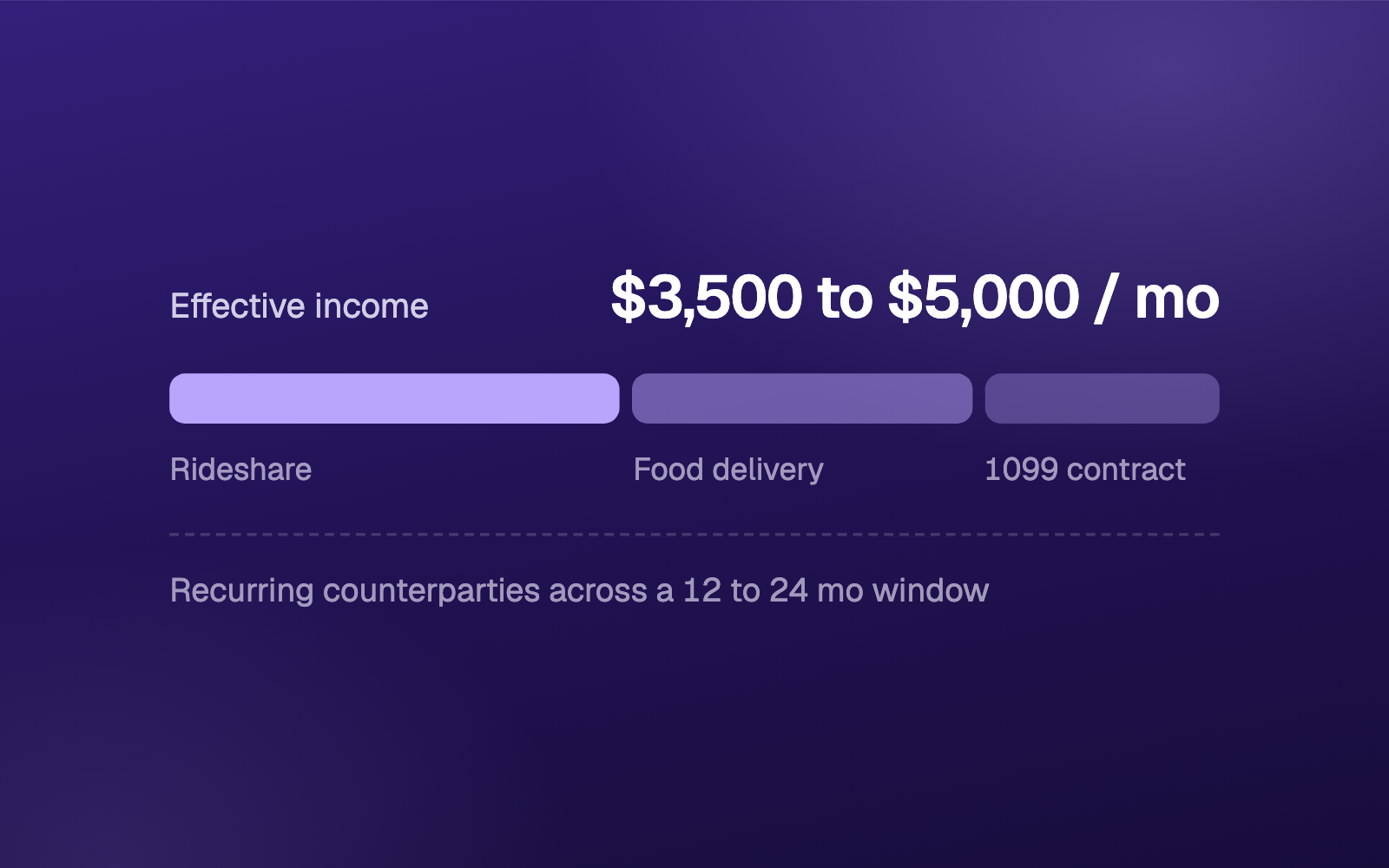
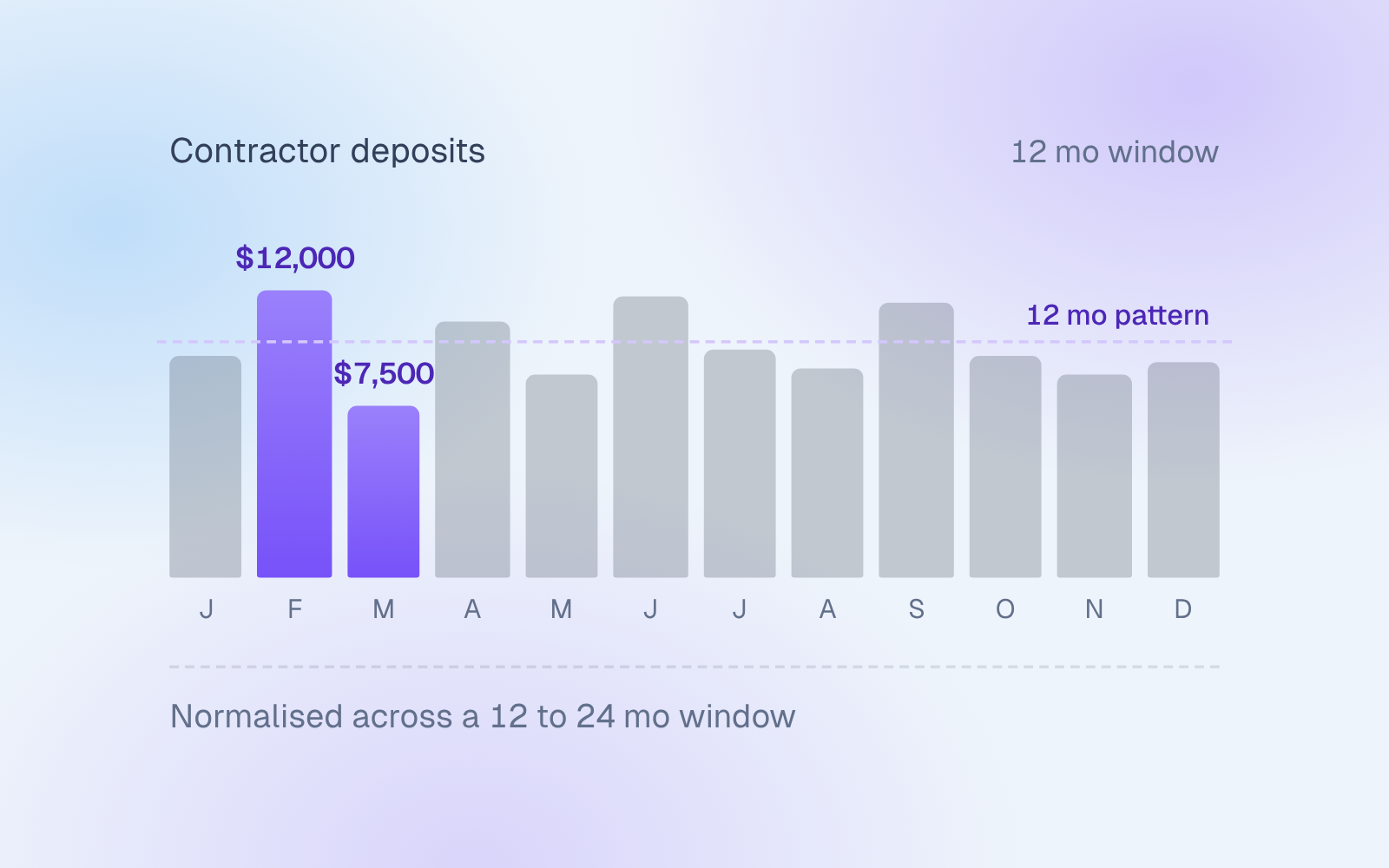
Contractors and freelancers billing on 1099s typically have cleaner income documentation than small business owners — their income arrives as direct deposits from clients rather than business account distributions — but it’s variable, often from multiple sources, and arrives on irregular schedules. A software consultant billing three clients monthly may have February income of $12,000 and March income of $7,500, not because their work situation has changed but because invoice timing is uneven. Standard income verification processes that look for consistent monthly deposits will flag this variability as a risk signal; cash flow analysis that looks at the 12-month pattern correctly identifies it as a stable income stream with timing variation.
Skilled Tradespeople
Electricians, plumbers, HVAC technicians, and similar tradespeople operating their own businesses represent a particularly large sub-segment in auto lending — they often need vehicles for their work, have strong earnings, and are chronically underserved by standard income verification processes. Their income is typically a mix of business checks, Venmo and Zelle payments from residential customers, and occasional direct deposits from commercial clients. But their transaction records, viewed holistically, almost always show a pattern of consistent, substantial deposits from identifiable trade-related sources.
Immigrant and Non-Traditional Income Borrowers
A distinct and often overlooked sub-segment: immigrant borrowers who are self-employed or run small businesses, have strong cash flows, but have thin or non-existent US credit files. These borrowers have the most to gain from cash flow underwriting — their income is real, their financial behaviour is responsible, and their credit invisibility is an artifact of credit file history, not financial capacity. Bank transaction data bypasses the credit file entirely and evaluates the financial behaviour that actually predicts loan performance.
A Schedule C borrower who grossed $180,000 and reported $65,000 in net income after legitimate deductions has real income that their tax return systematically undersells. Standard income verification will under-approve them. Bank transaction data shows the full picture.
Why Standard Verification Processes Fail Each Sub-Segment
For small business owners, the primary failure is tax return reliance. Asking a Schedule C borrower to submit two years of tax returns and using the net income figure as the basis for the income calculation systematically under-approves them. The solution is bank transaction data, which shows gross cash flows into the business and personal accounts before deductions — a much more accurate picture of actual financial capacity.
For contractors and freelancers, the primary failure is income consistency scoring. Variable monthly income from project billing is not a risk signal — it’s a structural feature of project-based work. Verification processes that look for payroll-like consistency will systematically misclassify stable-but-variable contractor income. Transaction data analysis over a 12 to 24 month window normalises for timing variation and correctly identifies stable income streams.
For tradespeople, the primary failure is documentation completeness. Asking a plumber to provide pay stubs or a formal employment verification letter produces nothing useful. Automated transaction analysis that identifies trade-related deposit patterns and separates business income from personal transfers is what makes this segment approachable at scale.
For immigrant borrowers, the primary failure is credit file dependence. No credit file doesn’t mean no financial capacity — it means the credit history data doesn’t exist. The entire value of cash flow underwriting for this segment is that it evaluates financial behaviour directly from the transaction record, bypassing the credit file dependency entirely.
How KoraConnect Handles Self-Employed Income Verification
KoraConnect is designed to handle all of these sub-segments within a single workflow. The borrower connects their bank account or uploads statements through the KoraConnect portal — the same process regardless of employment type — and the platform does the analytical work of identifying income sources, normalising for variability, separating business and personal transactions where they’re mixed, and calculating a reliable effective income figure.
The output is structured for dealer and lender use: a verified income figure, a breakdown of income sources, a net cash flow assessment, a debt service coverage calculation, and a composite Kora Score that integrates these factors into a single decision signal. The report also includes any anomaly or risk signals that warrant attention — declining income trends, overdraft patterns, unusual account activity — so that the dealer or lender has a complete picture, not just an income number.
For the compliance dimension, KoraConnect operates as an FCRA-compliant consumer reporting agency, with the adverse action code structure, consumer disclosure capabilities, and dispute resolution process that self-employed borrower applications require. Dealers and lenders working with self-employed applicants face the same FCRA obligations as with any other consumer report — and KoraConnect is built to make meeting those obligations straightforward.
The Market Opportunity
The self-employed borrower segment represents a substantial market opportunity for dealers and lenders who can serve it well. The 4.7 million independent workers who earned over $100,000 in 2024 are not a fringe group — they’re a large, financially capable population that the auto lending industry has been systematically under-approving for structural reasons that better verification eliminates. The dealers and lenders who invest in verification processes that handle non-traditional income accurately will capture a disproportionate share of this segment as the workforce continues its shift toward self-employment.
KoraConnect is the tool that makes it possible. Built on direct bank data access, designed for the full range of self-employed income profiles, and operating within the FCRA compliance framework — it’s the verification infrastructure that turns the self-employed segment from a headache into a competitive advantage.
Ready to stop turning away self-employed borrowers?
See how KoraConnect handles the full range of non-traditional income profiles — in one workflow.